
Key Points
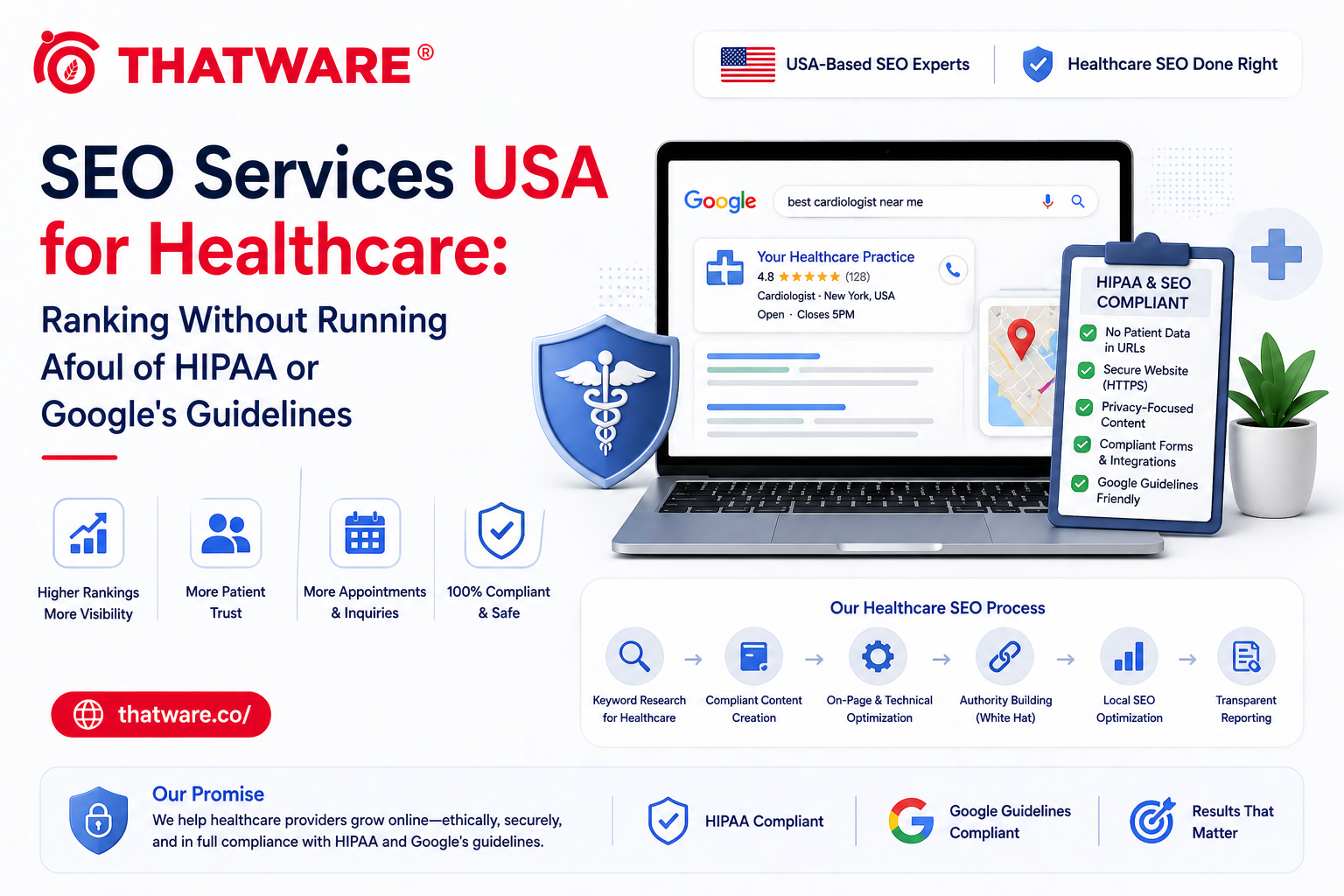
Healthcare SEO in the United States is one of the most complex and highest-stakes versions of the discipline that exists. You’re operating at the intersection of HIPAA’s patient privacy requirements, Google’s YMYL (Your Money or Your Life) quality standards, increasingly sophisticated search intent from patients who are more informed than ever, and a competitive landscape…
Healthcare SEO in the United States is one of the most complex and highest-stakes versions of the discipline that exists. You’re operating at the intersection of HIPAA’s patient privacy requirements, Google’s YMYL (Your Money or Your Life) quality standards, increasingly sophisticated search intent from patients who are more informed than ever, and a competitive landscape that includes health systems, insurance companies, pharmacy chains, and telehealth platforms with formidable marketing budgets.
Getting organic search right in this environment requires a level of sophistication that general-purpose SEO doesn’t. And getting it wrong — either through HIPAA violations tied to tracking implementations or through content that fails Google’s quality standards — carries consequences that range from patient trust erosion to regulatory penalties to significant ranking losses.
Let’s walk through what actually works, and what the specific compliance and quality challenges are.
Related reading: Learning Through Innovation: How Simple Electronics Spark Big IdeasThe HIPAA-SEO Intersection That Most Agencies Miss
HIPAA’s relevance to SEO is widely misunderstood, and that misunderstanding creates real risk for healthcare providers.
The most acute issue is tracking technology. Standard marketing analytics tools — Google Analytics, Meta Pixel, and similar — can potentially capture Protected Health Information (PHI) in ways that violate HIPAA, depending on implementation. Specifically, if tracking tools are capturing URL strings that include health condition information, appointment types, or patient identifiers, or if they’re being used to build advertising audiences based on health-related behaviours, HIPAA risk is present.
The HHS Office for Civil Rights has been increasingly active in this area. A 2022 bulletin clarified that tracking technologies on HIPAA-covered entities’ websites that collect PHI require appropriate safeguards — including Business Associate Agreements with technology vendors where applicable and data use limitations.
Related reading: How Privilege Escalation Attacks Threaten Your NetworkFor SEO specifically, this affects keyword-level conversion tracking (which may capture condition-specific information in URL parameters), remarketing audience creation (which in some implementations creates audiences based on health-related page visits), and analytics configurations that store personally identifiable information alongside health-related engagement data.
A healthcare SEO engagement that doesn’t include a thorough audit of tracking implementation for HIPAA compliance is incomplete, regardless of how sophisticated the keyword strategy is.
Google’s YMYL Standards in Healthcare
Google’s Quality Rater Guidelines apply particularly stringent standards to healthcare content under the YMYL framework, and those standards have real ranking implications.
Related reading: Proximity Sensor: An Essential Electronics ComponentThe specific addition of “Experience” to what was previously E-A-T (Expertise, Authoritativeness, Trustworthiness) matters significantly for healthcare. Google’s quality evaluators are instructed to assess whether content demonstrates real experience with the topics covered — which for healthcare means content that reflects genuine clinical expertise, real patient experience where appropriate, and accurate representation of the evidence base.
Content that’s written to keyword targets by generalist writers without genuine healthcare expertise — even if it’s grammatically correct and well-structured — consistently underperforms against content that demonstrably comes from people with real clinical knowledge in Google’s quality evaluation for healthcare topics.
The practical implications for seo services usa healthcare clients are specific. Medical content should be produced or reviewed by qualified healthcare professionals. Author credentials should be explicitly stated on content pages. Content should accurately represent the current clinical evidence base, including acknowledging uncertainty where it exists. Health claims should be appropriately qualified.
Related reading: Top 10 Questions Answered About Blockchain’s Impact on IndustriesClinics, hospitals, and healthcare service providers that have invested in content quality at this standard consistently outperform competitors who’ve taken shortcuts in the YMYL environment.
Local SEO: The Highest-Impact Channel for Most Healthcare Providers
For most healthcare providers — physician practices, dental offices, specialty clinics, therapy practices — local SEO is where the most significant organic search opportunity sits. Patients search for healthcare with strong local intent, and the local search results (Google Maps pack, local organic results) drive a disproportionate share of new patient acquisition from search.
Getting local SEO right for healthcare requires several specific elements.
Related reading: 20 Frequently Asked Questions about Building Your Custom PC AnsweredGoogle Business Profile optimisation matters enormously and is chronically underinvested in by healthcare practices. A complete, accurate, actively managed GBP — with specific service categories selected, accurate hours (including holiday variations), high-quality photos, and a systematic response to reviews — outperforms neglected profiles consistently.
The review challenge in healthcare is specific. HIPAA means that practices cannot respond to reviews in ways that acknowledge the reviewer as a patient or that reference any aspect of their care. This creates a constrained response environment that needs to be navigated carefully. Responses that acknowledge the feedback without acknowledging the reviewer’s patient status are possible and appropriate.
Review acquisition for healthcare providers is also HIPAA-constrained — practices should not target review requests based on clinical information, and post-visit review request systems need to be implemented in ways that don’t constitute impermissible disclosure.
The NAP (Name, Address, Phone) consistency across healthcare directories — Healthgrades, Zocdoc, Yelp, WebMD, and dozens of specialty-specific directories — has significant local SEO implications and is a specific area of maintenance work that healthcare practices often neglect.
Content Strategy for Healthcare: Finding the Right Approach
Healthcare content strategy involves navigating a tension between what ranks and what’s appropriate to publish. The resolution of that tension requires genuine strategic thinking rather than a content volume approach.
Symptom and condition content is the highest-volume category in health search, and it’s also the most competitive — dominated by WebMD, Mayo Clinic, Healthline, and similar established health information properties that have built extraordinary topical authority over decades. For most local and regional healthcare providers, competing head-to-head with these properties for broad condition-based terms is not a winnable strategy.
The content opportunities that are both realistic and appropriate for most healthcare providers are different. Local condition content — “managing diabetes in [city/region]” — has meaningful local search volume and is within reach for providers with appropriate clinical expertise. Procedure-specific content — detailed information about specific procedures offered — is highly relevant to bottom-of-funnel searchers and is an area where providers have genuine authority. Provider-specific content — detailed physician and practitioner pages that communicate credentials, expertise, and approach — supports both patient trust and local search performance.
Seo consultants usa working in healthcare should be having an honest conversation about which content categories are realistic and appropriate for the client, rather than pursuing broad symptom content in competition with established health information publishers.
Technical SEO Considerations for Healthcare Sites
Healthcare websites have specific technical characteristics that create SEO challenges worth understanding.
Patient portal integrations — the systems through which patients access records, schedule appointments, and communicate with providers — typically create authentication-required content that search engines can’t access, and sometimes create URL structures or subdomain configurations that fragment the site’s authority in ways that need to be managed carefully.
Appointment scheduling systems and their integration with the main website raise both tracking compliance questions (above) and technical SEO questions — ensuring that appointment booking flows are structured in ways that don’t create indexable low-value pages or crawl budget waste.
Multi-location practices have specific technical challenges around managing location pages that are differentiated enough to have genuine SEO value without creating thin duplicate content across dozens of similar location pages.
Healthcare websites that have grown through acquisition or merger often have complex domain consolidation questions — when to 301-redirect acquired practice websites into the parent organisation’s domain, when to maintain separate domains, and how to manage the authority consolidation in each case.
Telehealth and the National Competitive Landscape
The telehealth sector has specific SEO dynamics that differ from traditional healthcare provider SEO.
Telehealth services compete for national or multi-state organic search visibility, not local. The competitive landscape includes well-funded direct competitors (Teladoc, MDLive, etc.) and increasingly, health systems that have expanded their telehealth offerings. The keyword environment is highly competitive for broad terms and more accessible for condition-specific or specialty-specific terms.
State licensure creates a specific content and geographic targeting challenge: a telehealth provider licensed in 35 states can’t serve patients in the other 15, which should be reflected in geographic targeting decisions but often isn’t, creating traffic that can’t convert into patients.
The HIPAA considerations for telehealth platforms are, if anything, more acute than for traditional practices, given the volume of digital interaction with patients and the typically more technology-intensive engagement model.
Measuring Healthcare SEO Performance
The right metrics for healthcare SEO depend on the type of provider and the specific organic search programme, but there are some consistent principles.
New patient acquisition from organic search — tracked as carefully as HIPAA constraints allow — is the ultimate metric. Not traffic, not rankings, not keyword counts: how many new patients came through organic search, and what’s the economic value of those patients?
Phone call tracking from organic traffic requires care in healthcare — the tracking numbers used need to be managed in compliance with patient communication guidelines, and the data collected needs appropriate protections.
Appointment requests or online bookings from organic landing pages are often more tractable to measure than phone calls, and for practices with robust online scheduling, represent a clean and measurable conversion event.
The integration of SEO performance measurement with the practice’s patient acquisition tracking — ideally connected to actual appointment completions and patient lifetime value — is where the most useful analysis happens, and where most healthcare SEO reporting still falls short.
The Bottom Line
Healthcare SEO in the US requires genuine domain knowledge — both of the SEO discipline and of the regulatory and content quality environment that healthcare operates in. Generalist agencies applying standard e-commerce or B2B SEO frameworks to healthcare clients consistently produce inadequate results, because the compliance constraints, the content quality standards, and the competitive dynamics are all specific to the healthcare context.
The providers that invest in genuinely capable, healthcare-specific SEO support build organic search channels that produce consistent new patient flow at a cost per patient acquisition that compares favourably with paid search, especially over the long term. That investment, done properly, is one of the more durable growth assets a healthcare organisation can build.
Related Posts
Same section · next recordsTEC-0633 · 04 Jun 2026 · Technology

Learning Through Innovation: How Simple Electronics Spark Big Ideas
Some of the most memorable learning experiences don’t happen inside a textbook. They happen…
TEC-0515 · 20 Feb 2026 · Technology

How Privilege Escalation Attacks Threaten Your Network
Getting into a network is only half the battle for an attacker. Initial access…
TEC-0448 · 01 Oct 2025 · Technology

Proximity Sensor: An Essential Electronics Component
In today’s fast-evolving world of technology, electronics components play a pivotal role in building…